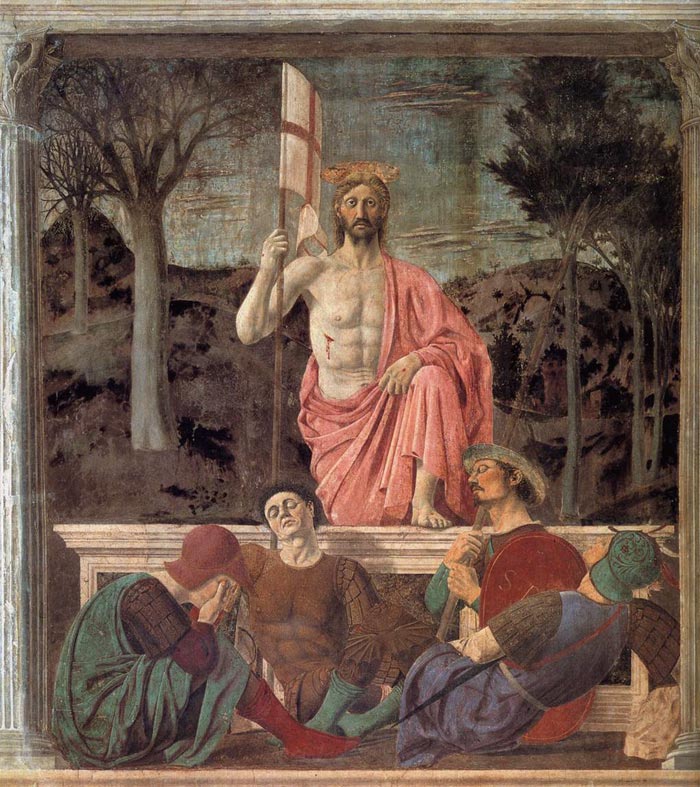
Piero della Francesca, The Resurrection, 1460’s, Museo Civico of Sansepolcro https://www.travelingintuscany.com/art/pierodellafrancesca/resurrection.htm
This past summer as part of our Nourish reading group, I had the opportunity to contemplate The Resurrection by Piero della Francesca and then discuss it with a group of wise women. I was and remain a novice to art criticism, and so I greatly benefitted from observing this artwork with a group. Together we noted the guards’ anachronistic clothing and the detailed musculature of Christ and the guard in brown, characteristic of the Renaissance period. We observed that Christ is stepping up out of a coffin, not out of a tomb from which a stone could be rolled away as in the biblical account. Through this artistic inaccuracy, he is allowed to adopt a posture of casual triumph. We connected this fresco to Josef Pieper’s Leisure: the Basis of Culture, which we had just read together. Christ’s pose is active, but also restful; there is stillness in his face. Is he at leisure? And the guards are clearly idle and neglecting their vocation. Perhaps they are suffering from acedia, a despairing refusal to be the guards they ought to be. This risen Christ is triumphant even over our sins of acedia, our refusal to be what we were made to be. Most of all I was drawn to Christ’s face, but was unsure how to interpret his expression until Wendell Barry gave me the key in his poem Early in the year by my friend’s gift – “We who see see we are forever seen.” This risen Christ sees all and is surprised by nothing. He sees me and he knows me.
How refreshing to meditate on truth, goodness, and beauty alongside other Lutheran mothers during the brief respite of summer! August came quickly, and each of us reengaged in the good work set before us. Part of my work this school year has been to lead my daughter’s class of 10th graders through a study of Western Cultural History, and in so doing I have been viewing more paintings. Imagine my surprise when I stumbled across this piece by Mariotto di Cristofano while perusing a book of art:
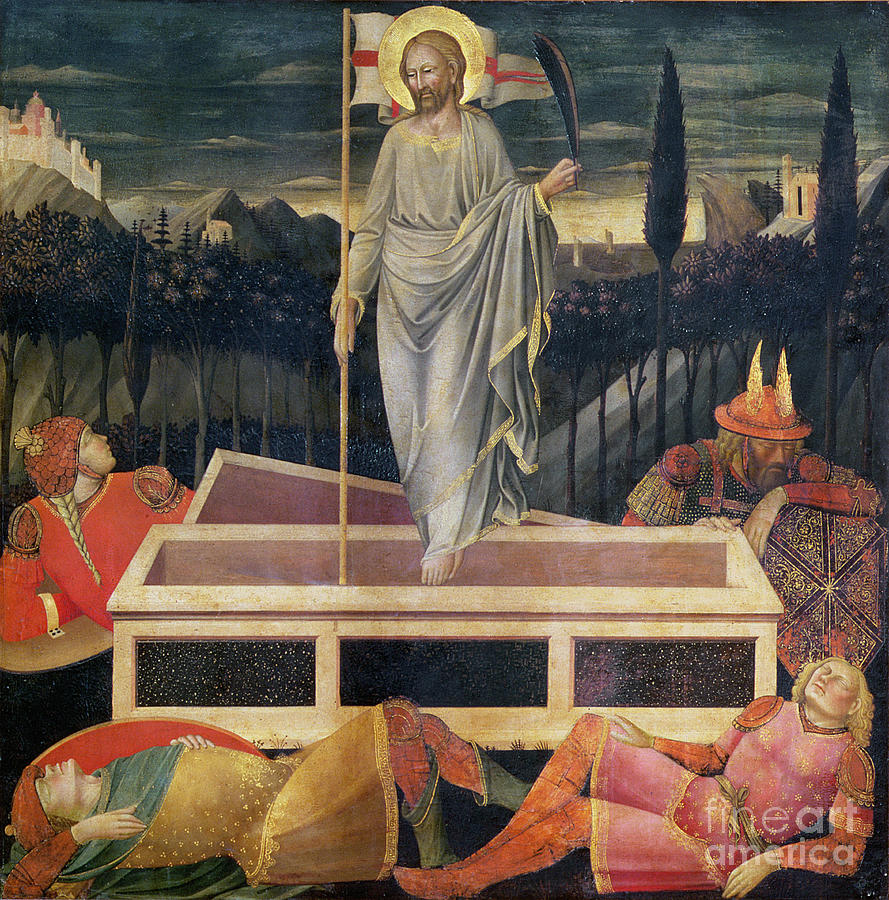
Mariotto di Cristofano, Resurrection, 1445, Accademia, Florence
https://fineartamerica.com/featured/the-resurrection-of-christ-mariotto-di-cristofano.html
I was immediately reminded of Piero della Francesca. It turns out that this style of resurrection painting was popular in the Renaissance time period, and many artists created works of similar type. There is a particular joy in recognition, in tracing a single idea through a chain of great works that it has inspired. Through the work of these masters, I too can engage with the idea that captivated them.
Connections like this can be made across media as well. This fall my class was tasked with choosing an artwork about which to give a persuasive speech, and so we spent a lovely afternoon wandering galleries in a local museum. My daughter selected Lucretia, by Rembrandt, in part because she remembered her tragic story from a book of Roman history we had read aloud together. She remembered how the rape and subsequent suicide of Lucretia spurred the overthrow of the monarchy and the eventual founding of the Roman republic. She remembered Horatius at the Bridge, Thomas Babington Macaulay’s poem describing a battle in the resulting war between Rome and the Etruscan kings. And so she revisited those old familiar sources, and discovered also Shakespeare’s poem The Rape of Lucrece to furnish depth to her understanding of the tragedy as well as a beautiful exordium for her speech. How rich that my daughter can view the tragic end of Lucretia, a woman of the 6th century BC, not only through modern retellings of her history, but also through the eyes of a 17th century English playwright, a 17th century Dutch painter, and a 19th century English poet! Her perspective on the death of Lucretia is not limited by the narrow confines of our own time and place; instead, thinkers of varied backgrounds spread before her a great conversation in prose, verse, and paint.
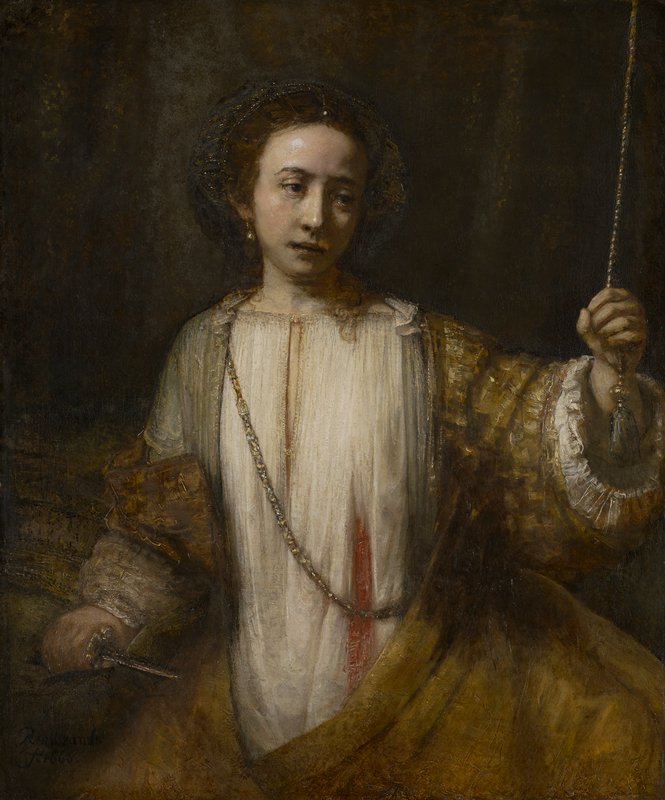
Rembrandt van Rijn, Lucretia, 1666, Minneapolis Institute of Art
https://collections.artsmia.org/art/529/lucretia-rembrandt-van-rijn
While not entirely lacking, my education was not replete in these cultural guideposts. Yet they stand waiting to be found, still accessible. It is an absolute joy to stumble upon them now, as I endeavor to give my children a classical education. It is as if we are exploring a foreign ecosystem together. When first you dip your toes into the stream, the fish and waterplants you encounter are wholly unfamiliar. But the further in you wade, the more types you will begin to recognize. They become friends, and those old masters who introduce you and reintroduce you to each species will teach you to know and to love each one.
What threads have given you joy to trace through the ages with your learners? Share in a comment below!
Amanda Moldstad
Amanda Moldstad is a co-founder of the Lutheran Homeschool Association. She and her husband, John, homeschool their six children in Brooklyn Park, Minnesota.
 Blest the House
Amanda, what I love so much about classical education (whether that be my child’s or my own through things like Nourish) is the continuous current of ideas, images and music that flows from one thing to the next connecting emotions, humanity, truth, goodness, beauty, and our very souls. And each idea relates to a past idea yet spurns on a new one all at the same time. Thank you for these reflections. Tomorrow I will pull out Shakespeare which is gathering dust on my shelf right now! On to leisure!
LikeLike
Beautiful! I am so indebted to you Scholé girls for showing me that normal people can just pick up and read any great old book they desire, and for motivating me again and again to do it. Because you are right – the current flows, and you can follow it home to your soul. I don’t think I would have attempted, say, Plato’s Chariot allegory on my own if we hadn’t read it together years ago, but since then I’ve seen it pop up all over the place, both in direct reference and conceptually. It has enriched my mental landscape. It is so good to be able to contemplate, wrestle with, and discuss that current of ideas together.
Enjoy your Shakespeare leisure!
LikeLike
Really good. Thanks for sharing.
LikeLike
Thanks, Wade! I named it after you. 😉
LikeLike
Ha! Sent from my iPhone
LikeLike